
Why Starting with Maple Bear Preschool Gives Your Child a Head Start
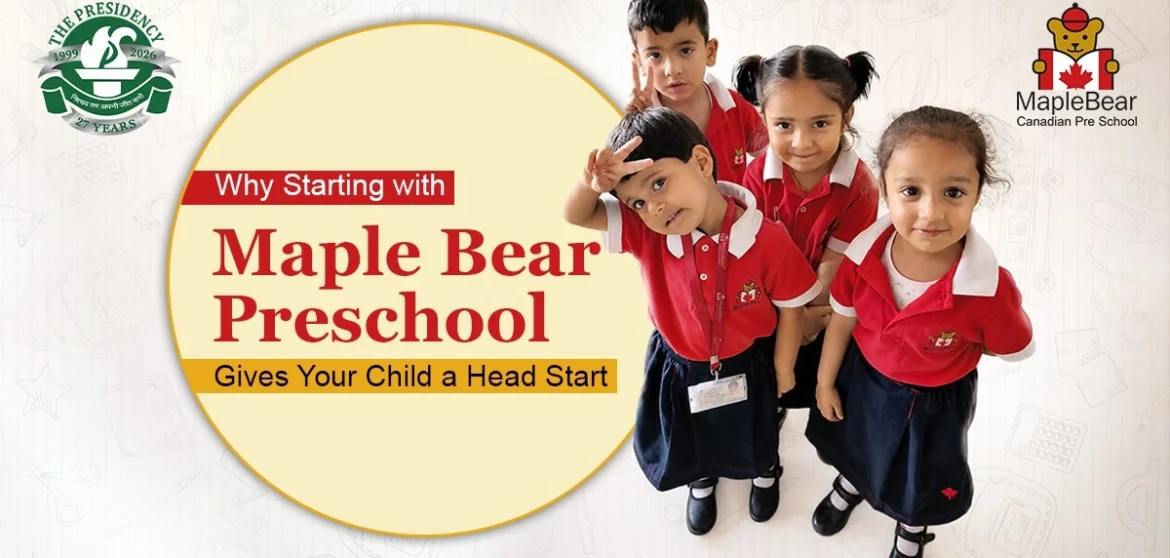
Why Starting with Maple Bear Preschool Gives Your Child a Head Start
The early years of a child’s life are often underestimated. There’s a tendency to think of preschool as a holding phase — somewhere to send kids before “real” school begins. But what actually happens between the ages of two and five has a bigger influence on how a child learns, socialises and handles challenges than most parents realise. The habits of thinking, the confidence with language, the ability to work alongside other children — these things take root early and they don’t disappear.
This is precisely why the choice of preschool matters more than it’s often given credit for. And it’s why the Maple Bear Preschool approach, rooted in Canadian early childhood education research, has built a reputation for giving young learners a genuinely meaningful start.
Maple Bear Preschool follows a play-based, research-backed early childhood curriculum developed in Canada. It focuses on building strong English language foundations, cognitive development through structured activities and social-emotional growth — all during the critical early years window. Children who go through this kind of structured yet playful learning environment tend to transition into primary school with better communication skills, stronger attention spans and a more settled sense of how to engage with learning.
Where Maple Bear Comes From
Maple Bear is a Canadian early childhood education programme that was developed based on decades of research into how young children learn best. Canada consistently ranks among the top countries in global education assessments and the Maple Bear methodology draws from the same principles that make Canadian early education effective — namely, that children learn most naturally through guided play, exploration and meaningful activity rather than rote learning.
The programme is designed for children from a very young age and builds progressively through the early years, making sure each developmental stage is properly addressed before moving to the next. It isn’t just about academic readiness. It’s equally concerned with how a child thinks, communicates, manages their emotions and relates to the world around them.
What Makes the Maple Bear Approach Different
There are quite a few preschool options available today and many of them look similar on paper. What sets Maple Bear apart is how deliberately its curriculum is constructed around how young children actually develop — not just what adults think they should be learning at a particular age.
Some of the things that make it distinct in practice:
• Play-based learning with purpose — Activities aren’t random. Play is used as the primary means of building specific skills, whether that’s language, fine motor coordination, number sense or social understanding.
• Strong English language focus — Maple Bear places significant emphasis on building early English language skills which makes a real difference when children move into English-medium primary schooling.
• Structured routine with room for exploration — Children in these early years need both consistency and curiosity. The Maple Bear structure provides a clear daily rhythm while still giving children space to explore, ask questions and engage at their own pace.
• Social-emotional development taken seriously — Learning to share, managing frustration, understanding others’ feelings and developing basic self-regulation — these are built into the curriculum, not treated as side concerns.
• Small group and individual engagement — Rather than a classroom of thirty being taught in one direction, early learning works better in smaller settings where a child’s individual progress can actually be noticed and responded to.
What the Maple Bear Preschool Curriculum Covers Day to Day
For parents who are used to thinking about school in terms of subjects and textbooks, the Maple Bear preschool curriculum might look different at first. There are no formal exams, no homework folders and no pressure to sit still for extended periods — because none of those things are developmentally appropriate at this age.
What the curriculum does include is a rich daily structure that works on multiple areas simultaneously. Language and literacy activities build vocabulary, listening and early reading readiness. Activities including numbers introduce basic mathematical thinking through counting, sorting and pattern recognition — in ways that feel like games. Art, music and storytelling nurture creativity and communication. And physical movement throughout the day supports coordination and body awareness.
The goal of all of this is to produce a child who is curious, communicative and ready to engage with structured learning when they move into primary school — not one who has been drilled on the alphabet before they were ready for it. This foundation matters a great deal when you consider what the primary school years will demand.
The Language Advantage That Carries Forward
One of the more lasting benefits of the Maple Bear approach is the early emphasis on English. In an English-medium schooling environment, children who arrive in Class I are already comfortable with the language and have a noticeably easier time settling in.
This isn’t about teaching English at the expense of the child’s mother tongue. It’s about giving children genuine exposure and confidence in a language they’ll spend the rest of their school years learning in. That early comfort makes everything else easier — reading, comprehension, writing and eventually the ability to think through problems in the language of instruction.
How It Sets Children Up for Primary School
The transition from preschool to Class I is one of the first big shifts a child faces. The environment becomes more structured, the expectations go up and the child is suddenly expected to sit, focus, follow instructions and engage with new concepts every day.
Children who have come through a well-structured preschool programme are meaningfully better prepared for that transition. They’re used to routines. They know how to sit with a group, listen and take turns. They’ve had enough guided learning experience that the structure of a classroom doesn’t feel overwhelming.
This readiness doesn’t happen automatically — it’s built, carefully, during the preschool years. And the approach matters a great deal. A programme that blends appropriate structure with genuine play, language exposure with creative freedom and individual attention with group interaction produces children who arrive at primary school confident rather than anxious.
For parents who are currently navigating the preschool selection process and aren’t sure where to begin, the detailed post on how to choose the best preschool in Dehradun for your child covers the key evaluation factors practically and without jargon.
What to Keep in Mind When Choosing a Preschool
A few things consistently make a difference in preschool quality, beyond the name on the brochure:
• Teacher-to-child ratio — The lower, the better. Young children need attention and a teacher managing twenty-five three-year-olds cannot give any of them what they actually need.
• How the physical space is set up — Does it feel designed for children or does it feel like a miniaturised adult classroom? Safe, stimulating, child-scaled environments matter for this age group.
• How the school communicates with parents — In the early years especially, a school that keeps parents informed and involved is one that understands how child development actually works.
• Whether the curriculum is backed by a coherent learning philosophy — Not just activities for activity’s sake but a structured approach with clear developmental goals behind it.
Conclusion
The preschool years are not a waiting room before real education begins. They’re where curiosity is either encouraged or dulled, where language confidence is either built or left and where a child’s relationship with learning is shaped in ways that follow them for years. Choosing a preschool that takes this seriously — with a curriculum and philosophy built on genuine research into early childhood development — is one of the most practical things a parent can do for their child’s long-term academic journey.
For families in Uttarakhand looking for the best preschool in Dehradun, The Presidency International School at Haridwar Road, Bhaniyawala, offers the Maple Bear Canadian Pre-School as its dedicated early years programme — making it one of the very few institutions in the region to bring this internationally recognised methodology to local families.
The Presidency International School brings over 22 years of educational experience to the table and the Maple Bear programme here benefits from that broader institutional foundation — qualified and experienced early childhood educators, a safe and purposefully designed learning environment and a school culture that genuinely values the whole child rather than just academic results.
As children grow through the preschool years and into the primary and senior sections, they transition within the same institution into The Presidency’s ICSE-affiliated schooling all the way through Class XII — meaning the continuity of values, teaching quality and environment carries forward. So if you’re looking for an early year experience that gives your child real roots before the structured school years begin, The Presidency International School’s Maple Bear programme is a very strong place to start.