

Why AI, Robotics and STEM Education Matter for School Students
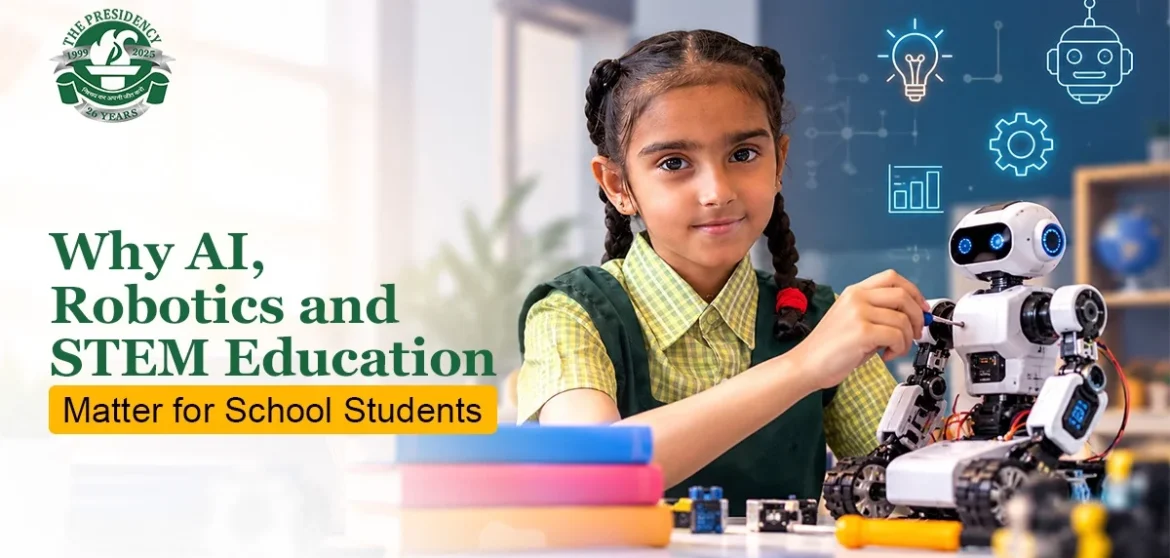
Why AI, Robotics and STEM Education Matter for School Students
Technology is changing the way people work, communicate and solve everyday problems. From artificial intelligence (AI) tools to automated machines, technology has become an important part of modern life. This makes it equally important for children to understand how these technologies work and how they can use them responsibly.
AI, robotics and STEM education help students develop practical knowledge, logical thinking, creativity and problem-solving abilities. By introducing these subjects at the school level, educators can prepare children to understand new technologies and adapt to the changing demands of the future.
Education today is not limited to learning facts and remembering information. Students also need opportunities to explore concepts, experiment with ideas and understand how classroom knowledge applies to real-life situations. This is where technology-based learning can make a meaningful difference.
What Is STEM Education and Why Is It Important?
STEM stands for Science, Technology, Engineering and Mathematics. It brings these four subjects together and encourages students to understand how they are connected in the real world.
For example, building a simple bridge model involves understanding scientific principles, using mathematical measurements, selecting suitable materials and applying basic engineering concepts. Instead of studying each subject separately, students learn how different areas of knowledge work together.
STEM education for school students is important because it helps them:
• Develop logical thinking and understand how to approach a problem.
• Apply scientific and mathematical concepts to practical situations.
• Improve their ability to analyse information and make decisions.
• Explore new ideas through experiments and project-based learning.
• Build confidence by finding solutions independently or working with others.
These skills are useful across different academic subjects and future career paths. Students do not necessarily need to become engineers or scientists to benefit from STEM learning. The ability to think logically, understand technology and approach challenges with confidence is valuable in almost every profession.
How Does Artificial Intelligence Help Students Learn?
Artificial intelligence refers to computer systems that can perform tasks commonly associated with human intelligence, such as recognising patterns, processing language, analysing information and making predictions.
AI is already being used in several areas, including healthcare, transportation, education and communication. Introducing students to its basic concepts can help them understand the technology they are likely to encounter throughout their lives.
In schools, AI can also support learning when used with proper guidance. For instance, students can use educational tools to understand difficult concepts, practise language skills or explore different approaches to solving a problem.
Learning about AI also introduces children to important questions about technology and responsibility. They need to understand that AI-generated information is not always accurate and that human judgement remains essential.
Some important lessons students can gain from AI education include:
• Understanding technology: Learning how computer systems process information and identify patterns.
• Critical thinking: Checking information instead of accepting every digital answer as correct.
• Digital responsibility: Understanding online safety, privacy and the responsible use of technology.
• Adaptability: Becoming comfortable with new tools and changing ways of working.
The purpose of introducing AI in schools should not be to make children dependent on technology. It should help them understand its uses, limitations and impact on society.
Why Should Students Learn Robotics at School?
Robotics brings together science, technology, engineering and mathematics in a practical way. It involves designing, building and programming machines that can perform specific tasks.
For students, robotics offers an opportunity to see how classroom concepts can be used to create something functional. A simple robot, for example, may require basic knowledge of circuits, sensors, movement and programming.
One of the most important aspects of robotics is that students learn through experimentation. Their first attempt may not work as expected. They may need to adjust a connection, change a command or rethink the design. This process teaches them to identify mistakes and improve their work.
Robotics can help students develop:
• Problem-solving skills: Understanding why a machine is not working and finding ways to correct it.
• Logical thinking: Giving instructions in the correct order to complete a task.
• Teamwork: Working with classmates to plan, build and test a project.
• Patience and perseverance: Learning that practical projects often require several attempts.
• Technical understanding: Becoming familiar with basic programming, electronic components and mechanical systems.
Robotics also gives students a chance to learn through curiosity. When they see how a machine responds to their instructions, they become more interested in understanding the technology behind it.
STEM Learning Activities That Make Classroom Concepts Practical
Students understand concepts more clearly when they get opportunities to apply what they have learned. Practical projects, experiments and group assignments allow them to explore ideas beyond textbooks.
Some useful STEM learning activities for students include:
1. Building Simple Machines: Students can create basic models using cardboard, wheels, pulleys or levers. This helps them understand mechanical principles and how machines make everyday tasks easier.
2. Designing a Basic Robot: With age-appropriate robotics kits, students can assemble simple robots and learn how sensors, motors and instructions work together.
3. Conducting Science Experiments: Activities involving water filtration, plant growth, magnets or simple circuits help students observe scientific concepts in action.
4. Creating Basic Coding Projects: Students can use beginner-friendly programming platforms to create simple animations, games or interactive stories. This introduces them to logical sequencing and computational thinking.
5. Designing Solutions to Everyday Problems: Teachers can ask students to develop simple models that address practical challenges, such as reducing water wastage or designing an energy-efficient house.
These activities can be adapted to different age groups. Younger children can begin with simple building and observation exercises, while older students can work on more detailed projects involving coding, electronics and design.
How Do AI, Robotics and STEM Prepare Students for the Future?
With technology becoming an important part of almost every industry, students need to develop skills that go beyond traditional academic knowledge. STEM education for school students provides an early introduction to scientific thinking, technological understanding and practical problem-solving, helping children become better prepared for future academic and professional challenges.
However, preparing students for the future does not mean training every child for a technical profession. It means giving them the knowledge and confidence to understand changes around them and respond to new challenges.
Exposure to AI, robotics and STEM can help students develop several transferable skills:
• Adaptability: The ability to learn new tools and adjust to changing situations.
• Analytical thinking: Understanding information, identifying patterns and making informed decisions.
• Creativity: Exploring different approaches instead of relying on familiar solutions.
• Collaboration: Sharing ideas and working with others to complete projects.
• Independent learning: Developing the confidence to ask questions, explore subjects and find answers.
These abilities can support students regardless of the subjects they choose in higher classes or the careers they pursue later.
What Should Parents Look for in a School’s Approach to Technology-Based Learning?
When selecting a school, parents should consider whether children receive opportunities to understand concepts through practical experiences. Access to computers and laboratories is useful but the way these resources are included in everyday learning also matters.
A school that encourages curiosity and active participation can help students develop a stronger interest in science and technology.
Some important aspects to consider include:
• Well-equipped computer and science laboratories: Students should have access to resources that support practical learning.
• Project-based activities: Classroom projects and experiments should encourage students to apply their knowledge.
• Teacher guidance: Educators should help students understand concepts and use technology responsibly.
• Academic and co-curricular exposure: Science exhibitions, workshops and competitions can give students opportunities to explore their interests.
• A balanced learning environment: Technology should support academic learning rather than replace reading, physical activities, communication and other essential aspects of education.
Parents exploring a top ICSE school in Dehradun should look beyond academic results and also consider how the institution encourages practical knowledge, independent thinking and the overall development of its students.
How The Presidency International School Encourages Learning Beyond Textbooks
The Presidency International School recognises the importance of providing students with opportunities to learn beyond regular classroom lessons. As a co-educational ICSE school in Dehradun, we focus on academic learning alongside intellectual, social and personal development.
Our approach to education includes a combination of classroom instruction, practical exposure and co-curricular participation. The school provides modern computer laboratories for junior, middle and senior-level students, giving them access to resources that support computer-based learning.
Students also participate in academic activities such as science exhibitions, inter-school competitions, hands-on workshops and other educational events. These experiences allow them to explore subjects, share ideas and develop confidence in presenting their work.
The school’s emphasis on logical thinking, learner participation and practical exposure provides a useful foundation for developing an interest in emerging areas such as AI, robotics and STEM. By encouraging students to ask questions, participate in activities and explore different subjects, the school supports the development of skills that extend beyond academic examinations.
Conclusion
AI, robotics and STEM education are becoming increasingly relevant to school learning because they help children understand technology while developing skills such as logical thinking, creativity, problem-solving and collaboration. Their value lies not only in introducing students to new tools but also in teaching them how to think, experiment and approach unfamiliar challenges with confidence.
The Presidency International School believes in an educational approach that combines academic excellence with opportunities for overall development. Our modern computer laboratories, science exhibitions, hands-on workshops and co-curricular activities provide students with opportunities to explore their interests and apply classroom knowledge in practical settings. With a focus on a rigorous curriculum, holistic development and personalised attention, the school aims to prepare students for the opportunities and responsibilities that lie ahead. Such an approach helps children build a strong foundation for continued learning in an increasingly technology-driven world.