

Why Practical Learning Is Important for School Children
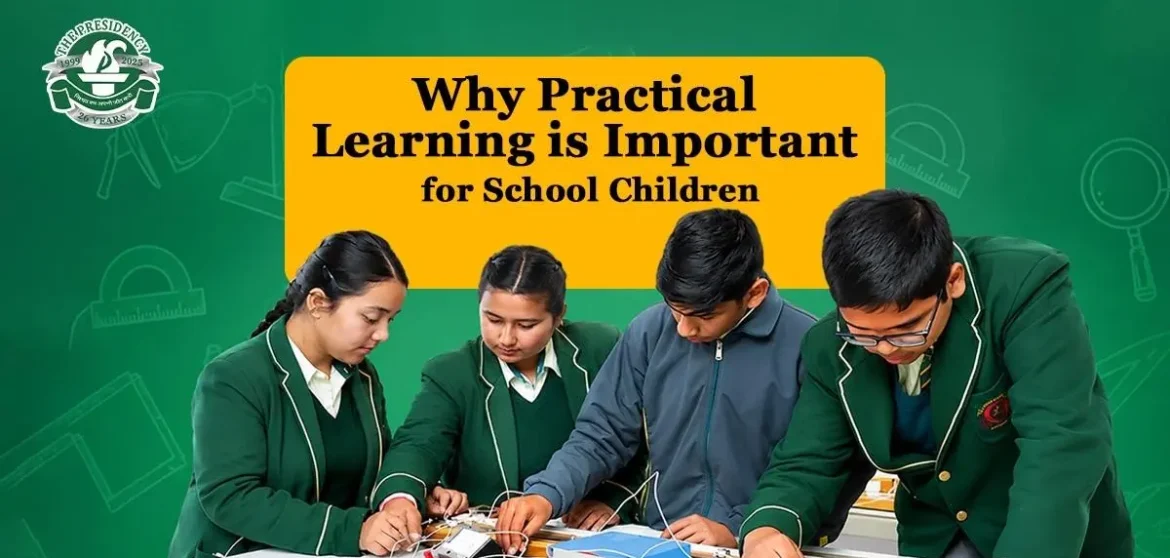
Why Practical Learning Is Important for School Children
Ask any parent what they remember from school and it’s rarely a chapter they memorised. It’s the science experiment that went slightly wrong, the school play they forgot their lines in, the model volcano that actually erupted. That’s practical learning doing its job — and it’s exactly why so many schools are rethinking how much time kids spend just reading about the world versus actually touching it.
Practical learning matters because it helps children understand concepts by doing, not just reading. It builds problem-solving skills, memory retention and confidence that pure textbook study often can’t. For school children, hands-on exposure turns abstract ideas into something they can apply in real situations, both inside the classroom and out.
What Does Practical Learning Actually Look Like?
It’s a broader idea than “science lab,” even though that’s usually the first thing that comes to mind. Practical learning for school children can show up in a dozen different forms across a school day:
• A maths class where students measure the actual classroom instead of solving problems on paper
• A geography lesson that includes building a relief map instead of just labelling one
• Group projects where kids research, plan and present something themselves
• Computer lab sessions where students code or build something instead of only reading theory
• Field trips, science fairs or even a simple gardening activity tied to a biology chapter
None of these replaces textbooks. They sit alongside them, giving the same information a second, more memorable route into a child’s brain.
Why Practical Learning in Education Actually Matters
There’s a reason the importance of practical learning in education keeps coming up in how modern curricula are designed, especially boards that emphasise conceptual understanding over rote memorising. When a child only reads about something, the information tends to stay abstract. It’s stored but it’s not necessarily understood in a way that sticks or transfers to a new situation.
Doing something changes that. A child who’s actually built a simple circuit understands electricity differently than one who’s only read the diagram. The same goes for a student who’s dissected a plant, calculated a real budget for a mock shop or debated a topic in front of classmates instead of just writing an essay on it. The concept stops being information and starts being knowledge they can use.
This is also why practical, project-based exposure has become a bigger part of how boards like ICSE structure learning — something we touched on in 10 Benefits of Choosing an ICSE School in India where hands-on application-based work is one of the clear advantages parents look for.
Benefits of Practical Learning for Students
The benefits of practical learning for students go well beyond just “remembering things better,” though that’s certainly part of it. A few that tend to matter most, especially in the early and middle school years:
• Better retention — information learned through activity tends to stay longer than information that’s only read or heard.
• Stronger problem-solving — when something doesn’t work the first time (and it often doesn’t), children learn to troubleshoot instead of giving up.
• More confidence — presenting a project or explaining an experiment builds comfort with speaking up which carries into other areas.
• Real-world connection — kids start seeing why a subject matters instead of treating it as something to pass an exam in.
• Collaboration skills — group activities and lab work teach children to work with others, split tasks and handle disagreement constructively.
None of these shows up neatly on a report card but they’re often what teachers and parents notice most when comparing children who’ve had consistent hands-on exposure with those who haven’t.
It’s Not Just About Labs and Field Trips
One thing worth clearing up — practical learning for school children doesn’t only mean science experiments or the occasional excursion. A lot of it happens quietly, through everyday classroom choices — a teacher who asks students to demonstrate rather than describe or a lesson that ends with an activity instead of a worksheet.
Co-curricular activities and sports also play a role here, since they teach discipline, teamwork and applied thinking in ways that are practical even when they’re not academic in the traditional sense.
The point is, practical learning isn’t a separate subject or a once-a-month event. It works best woven into how a school teaches everything, week to week.
Conclusion
Practical learning isn’t a trend schools are chasing to sound modern — it’s simply a more effective way for children to actually understand what they’re being taught. Between better retention, sharper problem-solving, more confidence and a genuine connection to real-world application, the case for hands-on learning is hard to argue with and it doesn’t need to be limited to science labs; it can (and should) show up across subjects and activities throughout a child’s school life.
This is an area The Presidency International School takes seriously. As one of the leading ICSE schools in Dehradun, the school is built around the idea that education works best when it’s a mix of rigorous academics and genuine hands-on exposure — reflected in its own guiding principle of “Rigorous Curriculum, Holistic Development and Personalized Attention.” Students have access to a well-equipped, air-conditioned library for deeper reading, modern computer labs across junior, middle and senior levels to keep pace with practical tech learning and a strong focus on co-curricular activities that build social and logical thinking skills alongside academics. Indoor and outdoor sports facilities give children regular exposure to the “field and practical world,” something the school views as central to how learning is enhanced, not incidental to it.
With over two decades of experience shaping students from Pre-School to Class XII, The Presidency International School continues to build an environment where children don’t just study concepts — they get to live them out, one hands-on lesson at a time.